
- Droit,
- Recherche,
Colloque DemoCIS | Analysis of Illiberal Regimes. Deciphering Democratic Deconsolidation
Colloque international organisé par Marie-Laure Basilien-Gainche, Professeure de droit public (CEE-EDIEC) à l'Université Jean Moulin Lyon 3, dans le cadre du projet DemoCIS
► Retrouvez les vidéos des interventions :
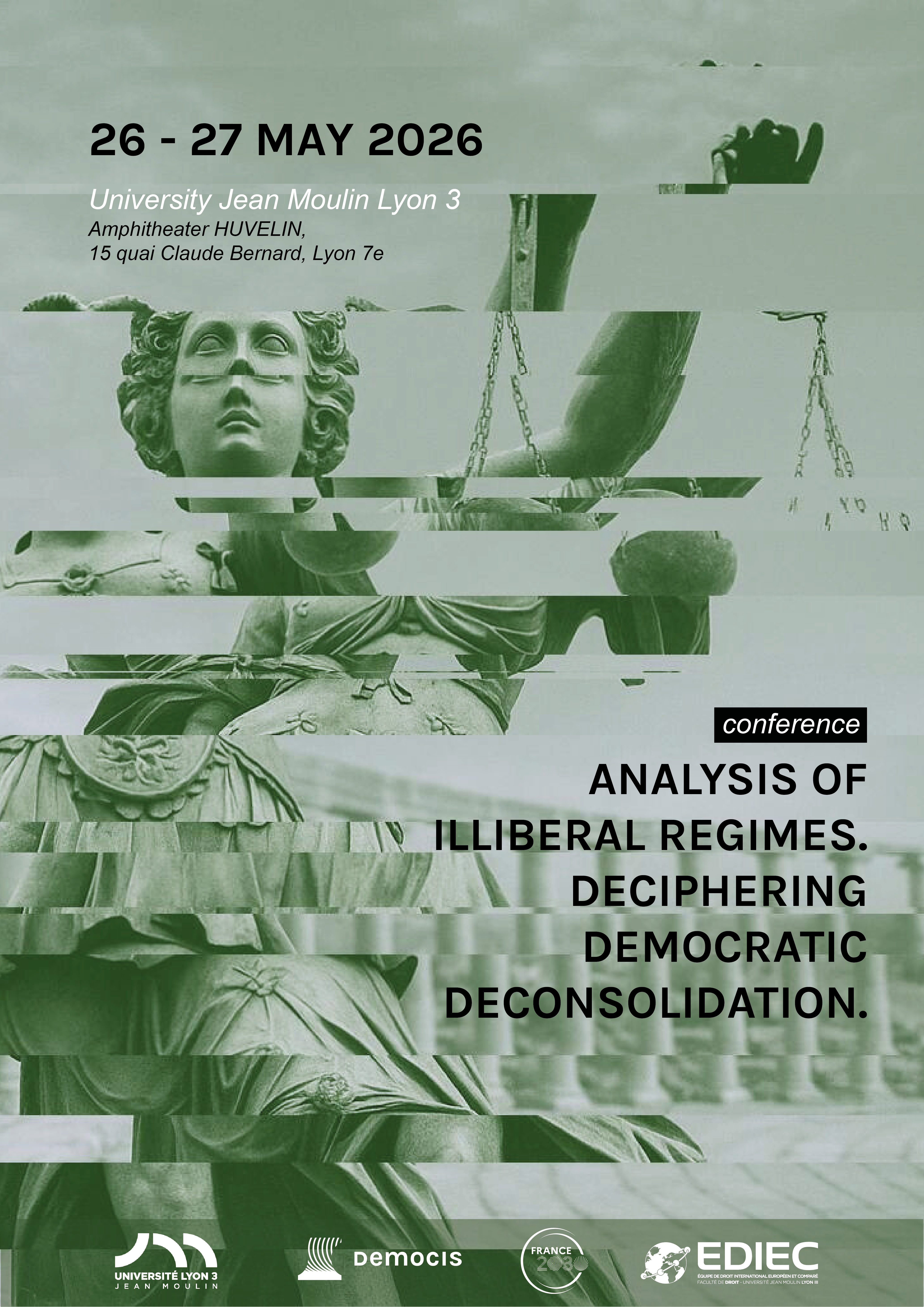
This international conference addresses one of the most pressing challenges to contemporary democracy: the rise of illiberal regimes and the erosion of democratic institutions in established democracies. Drawing on comparative perspectives from Europe, the Americas, the Middle East, and Asia, the conference examines how autocratic leaders systematically capture state institutions, dismantle the rule of law, erode separation of powers, and undermine fundamental rights — often through ostensibly legal means.
The conference is structured around four thematic panels. The first panel analyzes how illiberal actors access and colonize democratic institutions, exploring the global autocratization trend, the influence of far-right movements, and the propagation of illiberal ideology. The second panel investigates the dismantling of the rule of law through the expansion of executive power, the subjection of legislative bodies, and the capture of judicial independence. The third panel examines the denaturation of human rights protections, focusing on attacks against civil society, academic freedom, and the rights of non-nationals. The final panel explores potential pathways for resistance and democratic restoration, including European mechanisms for rule of law enforcement, American institutional resilience, and the role of technology in both enabling and countering authoritarian drift.
Through case studies from Hungary, Poland, Slovakia, Italy, Romania, the United States, Argentina, El Salvador, Turkey, Israel, and India, the conference brings together leading scholars and practitioners to advance our understanding of democratic deconsolidation and to identify strategies for defending liberal democratic values and institutions in an age of authoritarian resurgence.
PROGRAMME
- Tuesday 26th May 2026
-
14h00 - 14h15 | Opening
14h15 - 14h45 | IntroductionMarie-Laure Basilien-Gainche, Professor of Law, University Jean Moulin Lyon 3, Senior Member of the Institut Universitaire de France
14h45 - 16h15 | Keynote SpeechEurope in the Upside Down : The Parasitic Architecture of Democratic Backsliding in the European Union
- Dan Kelemen, Professor of Law, Georgetown University
16h15 - 16h45 | Pause
16h45 - 18h15 | Panel 1
Illiberal Regimes Accessing to Institutions : Observations and ModelisationChair : Carolina Simoncini, Assistant Professor in Italian Studies, University Jean Moulin Lyon 3The Autocratization Plateau ? The New Phase of Democratic Decline
- Luca Tomini, Professor of Political Science, Université libre de Bruxelles
From Normalisation to Transnational Coordination : How the Far Right Undermines Liberal Democracy- Léonie de Jonge, Professor of Research on Far-Right Extremism (Political Actors & Ideologies), Institute for Research on Far-Right Extremism (IRex), University of Tübingen
Resisting Mirror Propaganda : Militant democracies, Authoritarian Regimes and the Fight Against “Disinformation”
- Thomas Hochmann, Professor of Law, Université Paris Nanterre
- Wednesday 27th May 2026
-
9h00 - 10h30 | Panel 2
Illiberal Regimes Dismantling the Rule of Law (1) : The Balance of PowersChair: Mathilde Philip, Professor of Law, University Jean Moulin Lyon 3, Head of the Lyon Chair for Human and Environmental Rights
The Slow Design of Supremacy. Constitutional Hardball and the Shifting Legitimacy of Executive Power- Julien Jeanneney, Professor of Law, University of Strasbourg, Member of the Institut Universitaire de France
Ruling by Cheating : Compliance Theatre and Illiberal Defiance in Contemporary Constitutional Orders- Petra Bard, Professor of Law, Radboud University & Central Europe University
Autocratic Capture of the Judiciary : the Approaches by the Strasbourg and Luxembourg Courts and the Challenge of Navigating the Tension Between Purism and Faits Accomplis- John Morijn, Professor of Law, University of Groningen
10h30 - 11h00 | Pause
11h00 - 12h30 | Panel 3
Illiberal Regimes Dismantling the Rule of Law (2): The Human Rights ProtectionChair : Pierre-François Laval, Professor of Law, University Jean Moulin Lyon 3
Academic Freedom Under Illiberal Pressure in Europe
- Marie Padilla, Assistant Professor in Public law, University of Bordeaux
Putting Fuel to the Fire : Human Rights Violations and the Aggregation of Autocratic Power- Juliet Stumpf, Edmund O. Belsheim Professor of Law, Lewis and Clark Law School
The Illiberal Continuum : Discourses Delegitimising Human Rights- Jean-Yves Pranchère, Professor of Philosophy, Université Libre de Bruxelles
12h30 - 14h30 | Lunch Break
14h30 - 16h00 | Panel 4
Resisting and Restoring the Rule of Law: Hurdles and Ways ThroughChair: Gaëlle Marti, Professor of Law, University Jean Moulin Lyon 3
Restoring the Rule of Law Post Backsliding in a European Context
- Laurent Pech, Professor of Law, University College Dublin
Can the Rule of Law Be Restored in the United States ?- Anne Deysine, Emeritus Professor of Law, University Paris Nanterre
Montesquieu in Silicon Valley. The balance of technogical power- Olivier Alexandre, Executive Director of the Centre Internet et Société, CNRS
16h00 - 16h30 | Conclusions
Justine Lacroix, Professor of Political Theory, Université Libre de Bruxelles
Informations
Palais de l'Université
15 quai Claude Bernard, Lyon 7
Inscriptions
Programme
Qu'est-ce que le projet DemoCIS ?
Porté par l’Université de Lille, il rassemble 8 établissements (Sciences Po Lille, CY Cergy Paris Université-Sciences Po Saint-Germain-en-Laye, Université Jean Moulin Lyon 3, Université Grenoble Alpes, Sciences Po Grenoble, Inria, CNRS et IMT) et plus de 300 chercheur·ses, et entend relever quatre défis majeurs :
- Répondre à la crise des institutions par l’innovation démocratique ;
- Repenser les lieux et formes d’expression de la citoyenneté ;
- Agir contre la polarisation des sociétés et les désordres informationnels ;
- Renforcer les démocraties menacées face aux conflits et à l’insécurité.
En savoir plus sur DemoCIS