
A disability-friendly university
Choosing Jean Moulin Lyon 3 University means benefiting from unique support services designed to help you succeed and thrive in a high-quality environment.
Advisory services
- Student Disability Services
-
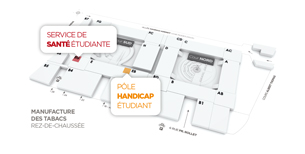
The University’s Student Disability Services team welcomes and supports students with disabilities throughout their studies. The Student Disability Services is the primary contact for guiding, informing and advising students, working in particular with the University’s teaching teams and services to develop adapted facilities (accessibility of premises, pedagogical support, alternative exam arrangements and assistance with professional integration).
- The Student Health Service
-
The Student Health Service is open to all Jean Moulin Lyon 3 University students. A multidisciplinary team is at your disposal to offer you a tailored prevention and care offer. Appointment confidentiality is guaranteed by professional secrecy. All services are free of charge and accessible by appointment without a French healthcare card (carte vitale). If you have a disability (due to motor, sensory or mental disorders, a chronic illness, intellectual or cognitive disabilities, speech and language issues, etc.) or a health condition requiring special arrangements, we recommend that you make an appointment with a doctor from the Student Health Service at the start of the academic year or when you enrol.
Procedures and mechanisms for alternative study and exam arrangements
- Procedure and support for alternative study arrangements
-
When they arrive at the University, students should contact the Student Disability Services team – before or after the appointment with the Student Health Service doctor. A needs assessment interview regarding university life may be offered to provide better support.
- Pedagogical support: amended timetable, study support, notetakers in class, etc.
- Accessibility: site visits and familiarisation with the premises, digitisation, adapted documents, etc.
- Alternative exam arrangements.
Each student is welcomed and supported by the University’s Student Disability Advisor and the accompaniment officers from the Student Disability Services.
Where required, the Student Disability Advisor will bring together a multidisciplinary team for the student’s project (teaching team, doctor, disability advisor, officer etc.), which will consider the enabling factors and difficulties encountered in the student’s studies, in order to propose support arrangements.
Students will be supported throughout the year with regular meetings, as necessary, to reassess the proposed arrangements. Disability advisor teaching staff are available in each of the University’s component entities.
- Procedure for alternative exam arrangements
-
If students require alternative exam arrangements – special equipment, personal assistance, extra time in assessments – they should contact the Student Health Service promptly, as soon as they arrive, to request alternative arrangements for their studies and/or for sitting exams.
Documents to be provided at the doctor’s appointment:- Support or alternative arrangements plan implemented in the previous institution
- Any up-to-date medical document indicating the diagnosis at the very least (letter, report, assessment, etc.)
+ prescriptions, medical test results (if relevant) translated into French or in English (or at least the conclusion if the report is long).
Note: to enable the student services centre to organise the exams, students should make an appointment with the Student Health Service:- Ideally before 15 October for the first semester
- Ideally before 20 February for the second semester
Assessment of needs
- What services can be offered?
-
In consultation with the Student Health Service doctor, several support arrangements may be offered, depending on the means available, such as:
- Implementation of adapted study programmes, in conjunction with student services and course directors (coordination of class timetables where possible, including requests to change groups, full or partial exemption from attendance requirements, interface with student services and teaching staff, etc.)
- Access to course content (several arrangements in function of the assessments and the needs identified for students)
Note: Access to course content is offered within a specific framework and cannot replace attendance at classes.
- Help with finding university facilities, classrooms, student services, etc.
- Individual academic tutoring
- Organisational tutoring, campus life – social life
- Study assistance: help with research and library work, and with travel, settling in and getting around
- During examinations: implement personal assistance (secretary, reader)
- Follow-up meeting (face-to-face or remote
Reception facilities
- the main reception desk,
- the individual study room,
- the multi-purpose area for assistance with daily living, comprising: a rest room (equipped with a hospital bed for resting or receiving specific care) and a dining room (containing a kitchen with a sink, fridge, microwave and fold-away tables). You can also use this room to work alone or in a group.
Campus accessibility
The Evelity wayfinding application
The University’s various Lyonnais campuses (Manufacture des Tabacs, Les Quais sites) are equipped with the Evelity application, an inclusive guidance solution that enables people with disabilities, and more generally all users, to find their way and move around independently on the campus.It comes as a free smartphone application, available for IOS and Android. Its strong point: it proposes the most appropriate route, taking into account the specific needs of users and the existing accessibility infrastructure.
Top tip: you can plan your way around the campus before you even arrive.
Download EVELITY (English version available):
► On IOS
► On Android
Maps and virtual tours
To help you find your way around the different University sites, check out the virtual tours and the University maps (print version available from the Student Disability Services or at the International Relations Department reception desk).
CONTACTS
Student reception is open every day from Monday to Thursday
Manufacture des Tabacs Campus | Espace rue Sud area | EB Building - ground floor
Tel. + 33 (0)4 78 78 78 01
handicap@univ-lyon3.fr
► Student Health Service
Book an appointment directly at the service reception desk, by telephone or online for certain consultations.
https://calcium-prdv.univ-lyon3.fr/
Manufacture des Tabacs Campus | Espace rue Sud area | EG Building - ground floor
Tel. + 33 (0)4 78 78 79 83